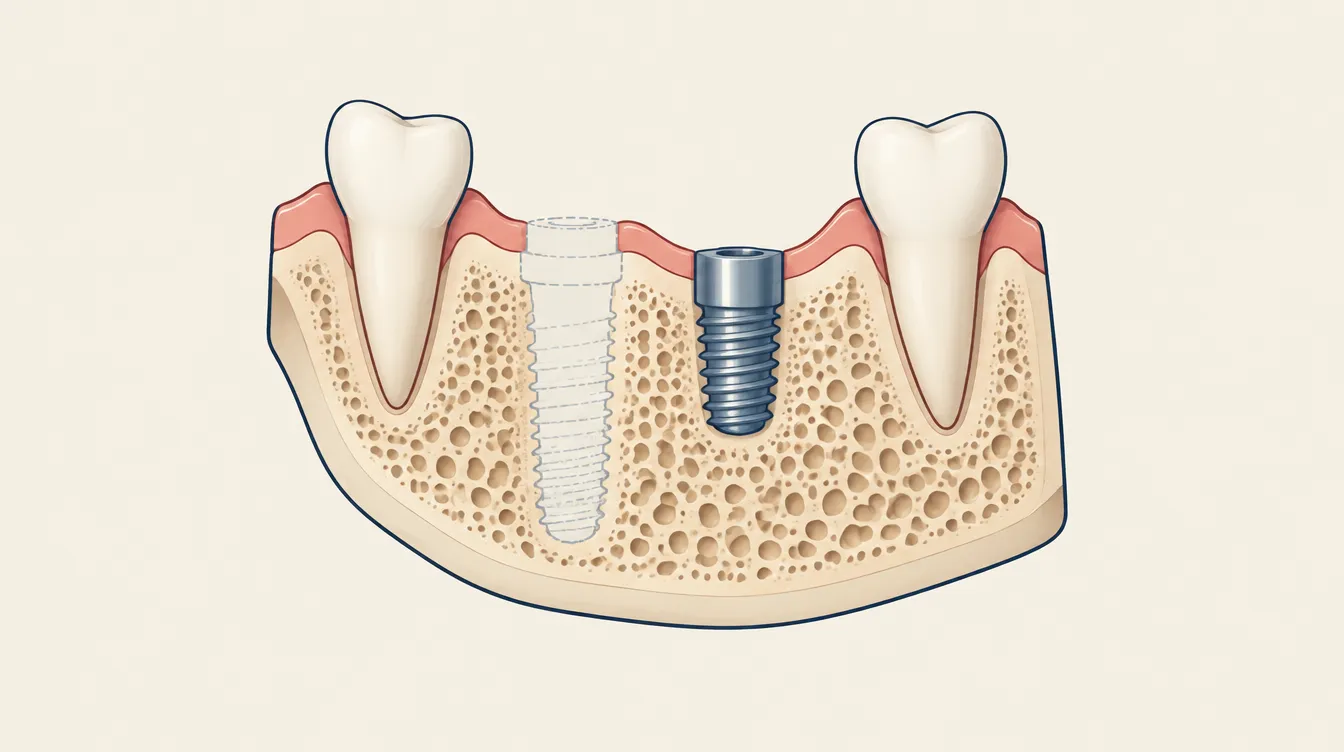
Why does an implant sometimes have to be removed?
When an implant has to come out, one of the following reasons is usually behind it:
- Peri-implantitis: inflammation of the tissues around the implant with progressive loss of supporting bone. According to the 2017 World Workshop report, a history of periodontitis, poor plaque control and not attending regular maintenance after implant therapy are supported by strong evidence as factors that increase the risk; the disease can start early and progress in a non-linear, accelerating pattern (Schwarz 2018). It can be treated in its early stages, but when bone loss is advanced and the implant has become mobile, removal may be necessary. See the peri-implantitis page for details.
- Failure to integrate (early loss): if the implant does not bond with the bone in the first months, it becomes loose and is removed.
- Fracture: of the implant itself or its connecting parts, seen especially with high chewing forces or clenching.
- Unfavourable position: implants placed at an angle or depth that does not allow a restoration or proper cleaning.
Removal is done with instruments designed to preserve as much of the surrounding bone as possible. How much bone survives the removal also sets the limits for what comes next.
How long does the site take to heal after removal?
After an implant is removed, a new one is usually not placed straight away; the socket is first allowed to heal, the inflammation to resolve completely and the bone to remodel. The time depends on the amount of bone loss, the severity of inflammation and the location; in practice it is a matter of months and is monitored with follow-up X-rays. In a cohort study of single implants, re-implantation took place on average 5.8 ± 5.2 months after removal of the first implant (Grossmann 2007).
This waiting period is also an opportunity to address the cause. If peri-implantitis was involved, the gum health around the remaining teeth and implants is brought under control; modifiable risk factors such as smoking, clenching and oral hygiene are discussed, and a night guard is planned if needed.
A 3D scan (CBCT) taken after healing shows, to the millimetre, the height and width of the remaining bone and its distance from structures such as the sinus floor or the lower jaw nerve. Whether a short implant or a graft is needed depends largely on this image.
Does a second implant in the same site succeed?
This question has been studied directly, and the picture should be presented honestly:
- In a cohort of single-tooth implants, 9 of 31 implants placed again in the same site were lost, a survival rate of 71%; all failures occurred within the first year after re-implantation (Grossmann 2007).
- Another study followed 79 re-implanted implants in 56 patients for a mean of about 30 months and reported a survival rate of 83.5%. The outcome was not associated with most factors such as smoking, implant length or location; the authors suggested that a negative effect of the site itself may play a role (Machtei 2008).
- A systematic review pooling seven studies calculated a survival rate of 88.84% at the second attempt (mean follow-up of about 42 months) and 74.19% at the third. The authors considered implant replacement a reasonably feasible option, but stressed that modifiable risk factors must be controlled beforehand (Zhou 2016).
So a new implant is possible, but it calls for more careful planning than the first attempt. Most of these data come from retrospective studies, and the implant types used may differ from today's. Still, they all carry the same message: no new implant should be placed before the question "why was the first one lost?" has been answered.
Why can a short implant help here?
When an implant is removed, particularly after peri-implantitis, a vertical bone defect often remains. To fit a new standard-length implant, this loss is usually compensated with larger procedures: vertical or horizontal bone augmentation with grafts (block grafts, guided bone regeneration) or, in the back of the upper jaw, an open sinus lift. These are well-documented methods, but they mean additional healing time, more swelling and their own risks of complications.
The minimally invasive question is: can the remaining bone safely carry a short implant? If it can, the same goal may be reached without a major augmentation.
The short-implant literature offers guidance. An ITI consensus report found survival rates of 86.7–100% for implants of 6 mm or less over 1–5 years of follow-up; it concluded that short implants are a valid option to avoid the possible side effects of augmentation, while noting that their outcomes are more variable (Jung 2018). A multicentre randomised trial comparing 6 mm short implants with longer implants placed with sinus grafting in the back of the upper jaw found no significant difference between the groups in survival, bone level or complications at five years (Thoma 2018).
These studies were not carried out in previously failed sites, so their results cannot be transferred directly to this situation. What they show is that when bone height is limited, a short implant is an option that can be considered instead of a large graft. For general information see the short implants page.
When is a short implant not suitable?
A short implant is not the right choice for every site where an implant was removed. A bone graft or an open sinus lift may still be the better route when:
- the remaining bone height is too low to support even a short implant safely,
- the bone is very thin or one of its walls has been largely lost,
- the gum and bone level must be rebuilt in an area with high aesthetic demands, such as the front teeth,
- a very long crown would sit on the short implant and the restoration design cannot offset this lever effect,
- the cause of the first implant's loss (untreated periodontitis, smoking, poor oral hygiene, uncontrolled clenching) is still present.
The last point matters most: a new implant placed without removing the cause faces a similar risk, whatever its length. For cases where the upper jaw bone is severely resorbed, see also the alternatives to zygomatic implants page.
Frequently asked questions
How long after removal can a new implant be placed?
A few months are usually allowed for the site to heal and the inflammation to resolve completely; one study reported a mean of 5.8 months (Grossmann 2007). Timing is set after examination and a follow-up X-ray, according to the amount of bone loss.
Will a second implant in the same site hold?
A systematic review reported a mean survival rate of 88.84% at the second attempt, somewhat lower than for implants placed in a site for the first time (Zhou 2016). To improve the odds, the cause of the first loss is identified and risk factors are brought under control first.
Can a short implant be placed where an implant was removed because of peri-implantitis?
In suitable cases, yes. If enough bone height remains after healing, a short implant may make a vertical bone graft or an open sinus lift unnecessary. Whether this is possible is determined with a 3D scan.
Can a new implant be placed in the same session as the removal?
In some selected situations, when there is no infection and enough bone remains, this can be considered. For implants removed because of peri-implantitis, healing is generally awaited first; the decision depends on the inflammation and the amount of remaining bone.
Is a bone graft always needed for a new implant?
Not always. If the bone loss is limited, a graft-free plan with short or narrow implants may be possible; if it is advanced, a graft may be needed. The right option is decided after examination and 3D imaging.
The right plan for a site where an implant was removed is decided after a clinical examination and 3D imaging, weighing the cause of the loss, the remaining bone and the restoration needed. A pre-assessment can start from an existing panoramic X-ray or CBCT. For other questions see the FAQ page, and for the overall approach the article on minimally invasive implantology.