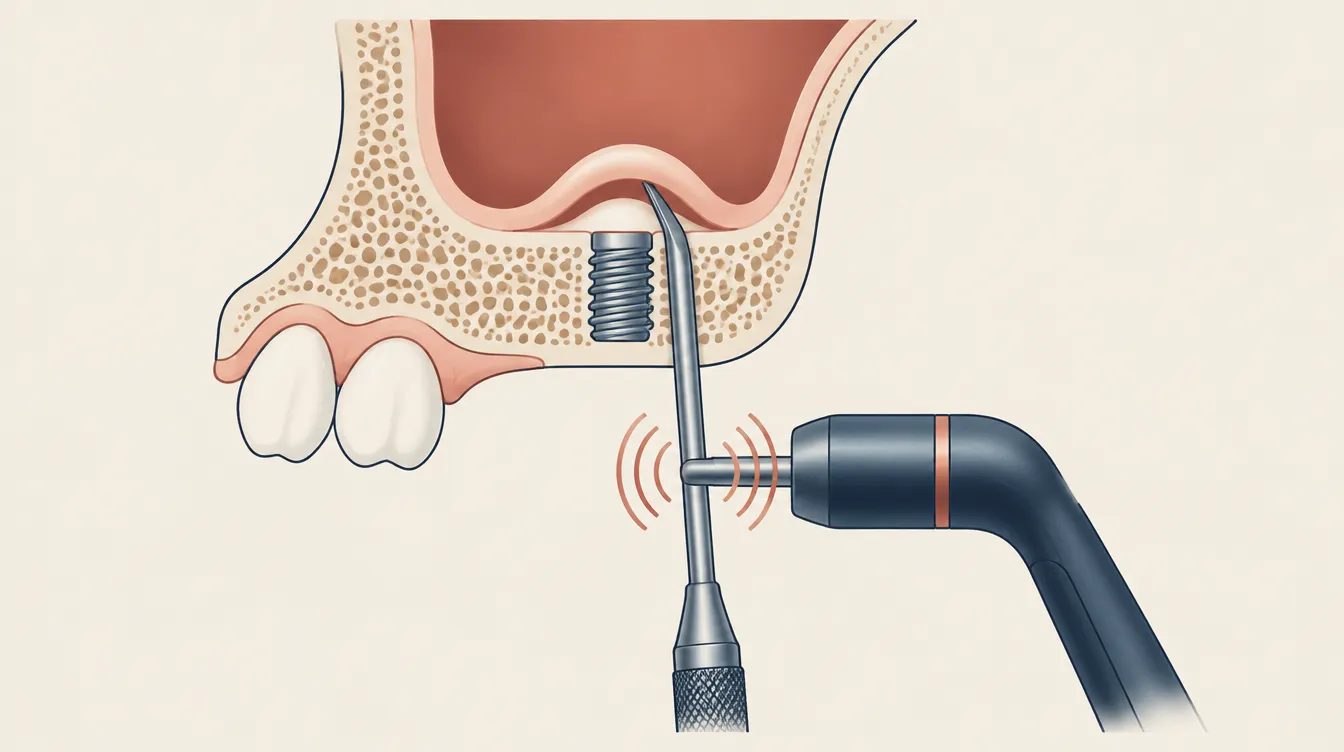
What is an internal sinus lift, and what does an osteotome do?
In the back of the upper jaw, just above the molars, lies the maxillary sinus. After teeth are lost, bone height in this area can decrease until a standard-length implant no longer fits. In an open (lateral) sinus lift, a window is opened in the side wall of the sinus; in the internal technique, the sinus floor is raised by a few millimetres through the very socket prepared for the implant, and no side window is needed.
The classic method for this is the osteotome technique described by Summers in 1994: progressively wider tapered instruments (osteotomes) are placed in the socket and tapped gently with a small mallet to push the sinus floor upwards. This approach is considered more conservative and less invasive than the lateral window technique; more than nine out of ten patients who experienced it were reported to be willing to undergo it again if needed (Pjetursson and Lang 2014). For details see the internal sinus lift page.
What is the drawback of the hand mallet?
What patients mention most about the osteotome technique is the tapping. Under local anaesthesia there is no pain, but blows that resonate through the head are quite unpleasant for some people and can increase anxiety during the procedure.
A rarer but known complication is benign paroxysmal positional vertigo (BPPV, brief dizziness triggered by head movements), which has been linked to the blows. Complications reported after internal sinus lifts include perforation of the sinus membrane (3.8% of patients), postoperative infection (0.8%), nosebleeds, haematomas and this type of vertigo (Pjetursson and Lang 2014).
In addition, with a hand mallet the force and direction of each blow depend entirely on the surgeon's hand; no two taps are exactly alike.
What is a magnetic mallet and how does it work?
A magnetic mallet (also called an "electric mallet" in the literature) is a device that uses an electromagnetic mechanism to deliver very short impulses of adjustable intensity to the handpiece holding the osteotome. The surgeon positions the instrument and triggers the impulse; its force and duration are standardised by the device.
The aim is to make bone condensation and elevation of the sinus floor more controlled for the surgeon and less jarring for the patient. Besides the internal sinus lift, the device is also used to condense soft upper-jaw bone and to expand narrow ridges.
What did the thesis find?
The specialty thesis prepared by Dr. Rouzbeh Fazeli at the Department of Periodontology of Ege University, under the supervision of Assoc. Prof. Dr. Nejat Nizam, studied this question in a randomised controlled clinical trial. It compared the magnetic mallet with the hand mallet in osteotome sinus floor elevation performed together with short implants. The outcomes assessed were:
- discomfort felt during surgery,
- postoperative pain during the first week,
- vitality of the neighbouring teeth,
- surgical time and number of strikes,
- the amount of sinus floor elevation.
The main finding was significantly lower surgical discomfort in the magnetic mallet group. The results were presented as a poster at the 2019 EAO (European Association for Osseointegration) congress in Lisbon, and the abstract was published in the congress supplement of Clinical Oral Implants Research. The abstract concludes that the procedure with the magnetic mallet caused less discomfort and pain, that both techniques are safe, and that the magnetic mallet has the potential to replace the hand mallet (Fazeli 2019).
The fact that the study was done together with short implants is meaningful too: combining a short implant with a few millimetres of internal sinus elevation is a typical example of the minimally invasive approach that aims to avoid an open sinus lift. That said, this was a single-centre specialty thesis; its findings need to be confirmed in other centres and in larger groups of patients.
What do other studies report?
Publications on the magnetic mallet are increasing, but the level of evidence is still limited:
- A randomised study comparing hand and magnetic mallets for bone condensation in the upper jaw included 50 patients and 138 implants; at 24 months survival was 97.10% with the magnetic mallet and 92.75% with the hand mallet, a difference that was not statistically significant. Vertigo (BPPV) was reported only in the hand-mallet group, in two patients (Crespi 2014).
- In a prospective study of 32 patients who received implants in fresh extraction sockets with simultaneous osteotome sinus lift using the magnetic mallet, the two-year cumulative survival rate was 98.57%; no membrane perforation, vertigo or nausea was observed (Crespi 2013).
- A systematic review of 14 studies summarised implant survival as 98.9% in magnetic mallet groups and 95.42% in control groups, and reported that all seven patients who experienced postoperative vertigo were in control groups. The authors stressed, however, that the results are not sufficient to establish effectiveness and that randomised trials with large samples are needed (Bennardo 2022).
That a substantial part of these data comes from the same research group calls for caution in interpretation.
What to expect on the day and afterwards
For the patient, an internal sinus lift with the magnetic mallet is not very different from the classic osteotome technique. It is done under local anaesthesia, usually in the same session as implant placement. A light vibration and sound are felt during the impulses; the "surgical discomfort" measured in the thesis relates precisely to this experience.
Aftercare is similar to standard implant surgery: patients are usually advised to use antiseptic rinses and, where indicated, antibiotics (Pjetursson and Lang 2014). In the first days you may be asked to avoid blowing your nose, heavy lifting and pressure changes such as flying. Healing and the timing of the restoration are decided at follow-up visits according to bone quality.
Who is it suitable for, and what are its limits?
The magnetic mallet is a tool; the indication is set by the internal sinus lift itself. The internal technique is most predictable when the residual bone height is about 5 mm or more and the sinus floor is relatively flat (Pjetursson and Lang 2014). A systematic review pooling 19 studies estimated a three-year survival rate of 92.8% for implants placed with this method, comparable to implants in non-augmented sites (Tan 2008).
In practice, the magnetic mallet may be considered for:
- cases where bone height is suitable for an internal sinus lift, especially when a few extra millimetres are needed together with a short implant,
- soft (low-density) upper-jaw bone where condensing the bone is preferred to drilling it away,
- patients who are particularly anxious about the mallet blows.
Its limits are also clear:
- If bone height is very low, an open sinus lift may be needed; the magnetic mallet does not change that.
- If the sinus floor is steeply sloped or divided by septa, or if there is untreated sinus disease, the internal technique may not be suitable.
- The magnetic mallet does not eliminate the risk of membrane perforation or vertigo; careful technique and case selection remain decisive.
- There is no evidence that the device improves long-term implant survival; the reported advantages concern comfort and control during the procedure.
Frequently asked questions
Does a sinus lift with the magnetic mallet hurt?
The procedure is done under local anaesthesia. In the thesis, discomfort during surgery was significantly lower with the magnetic mallet than with the hand mallet (Fazeli 2019). Postoperative tenderness varies from person to person and usually eases within a few days.
Does the magnetic mallet prevent vertigo?
In the studies, vertigo associated with the blows (BPPV) was reported mostly in hand-mallet groups (Crespi 2014; Bennardo 2022). The evidence is limited, however, and it cannot be said that the risk is eliminated.
Can the magnetic mallet replace an open sinus lift?
No. The magnetic mallet is a tool of the internal technique; if bone height is very low, an open sinus lift may still be necessary. Which method is suitable is determined with a 3D scan.
Do implants placed with a magnetic mallet last longer?
There is no evidence for this. Comparative studies found survival rates similar to the hand mallet; the reported advantage concerns patient comfort and control of the impulse during the procedure.
Can an internal sinus lift be combined with a short implant?
In suitable cases, yes. A short implant can be combined with a few millimetres of extra height gained with the internal technique, which may make it possible to proceed without a side window. See the short implants page for more.
Whether an internal sinus lift, a short implant or an open sinus lift is right for you is decided after a clinical examination and 3D imaging, weighing the residual bone height, the sinus anatomy and the restoration needed. A pre-assessment can start from an existing panoramic X-ray or CBCT. For other questions see the FAQ page, and for the practice where the treatment is carried out the implant dentist in Izmir page.