Patient guide · For patients
Dental implants with diabetes: HbA1c, healing and gum health
Can people with diabetes get dental implants? Why HbA1c matters, osseointegration, the gum disease link and planning that keeps surgery small.
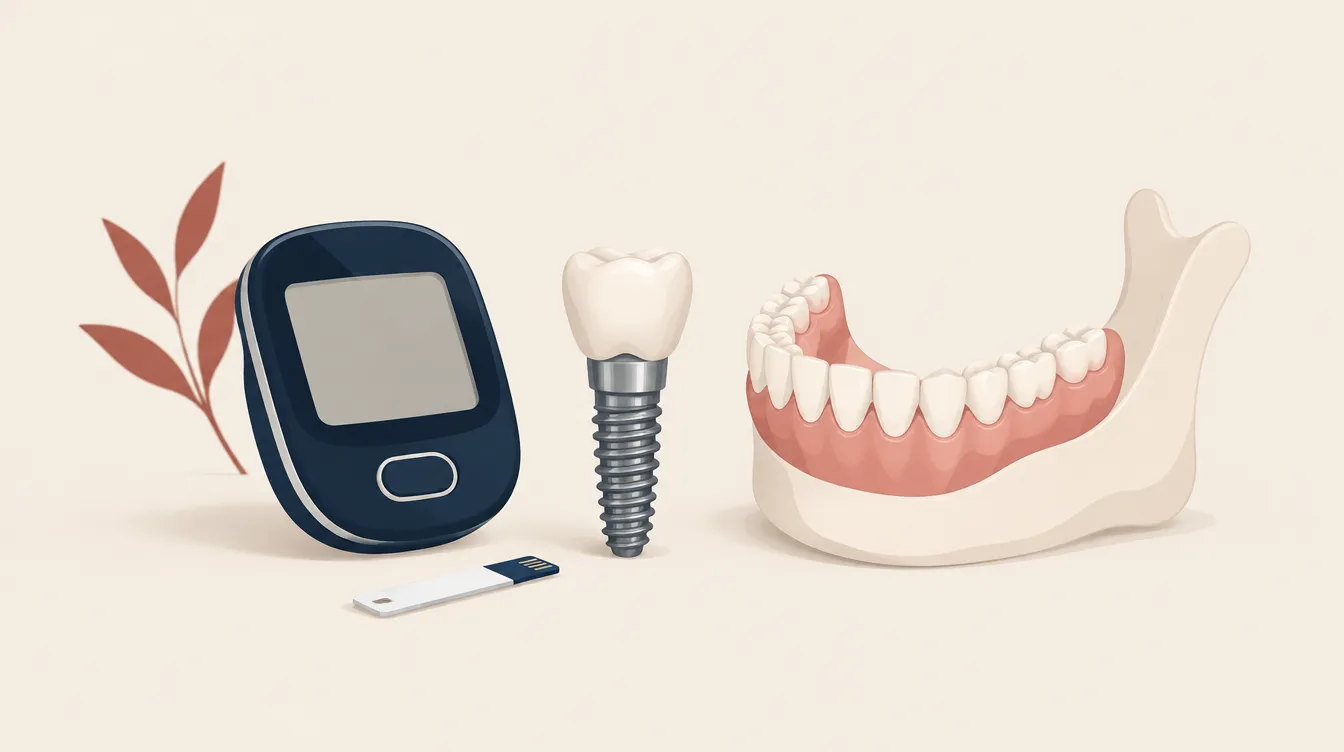
People with diabetes can have dental implants: when blood sugar is well controlled, studies report complication rates similar to those of healthy people, whereas in uncontrolled diabetes bone integration can be delayed and the risks of peri-implantitis and implant loss increase. That is why HbA1c is checked before implant treatment, any gum disease is treated first and surgery is kept as small as possible. This article explains the links between diabetes, gum health and implants, with what the literature reports and its limits.
How are diabetes and gum disease related?
Diabetes and periodontitis (advanced gum disease) have a two-way relationship. According to the joint workshop report of the International Diabetes Federation and the European Federation of Periodontology, people with periodontitis have an elevated risk of dysglycaemia and insulin resistance; in people with diabetes, periodontitis is associated with higher HbA1c levels, and periodontitis is also associated with an increased risk of developing type 2 diabetes (Sanz 2018).
In the other direction there is an important finding: periodontal treatment is safe and effective in people with diabetes. The same report found HbA1c reductions of 0.27–0.48% three months after treatment (Sanz 2018). A recent Cochrane review of 35 randomised trials showed, with moderate-certainty evidence, that subgingival cleaning was associated with an absolute reduction in HbA1c of 0.43% after 3–4 months (Simpson 2022).
These findings explain why implant planning in a patient with diabetes starts with the gums: treating gum disease matters both for oral health and for overall metabolic control. How gum disease is treated is described in the article what is a periodontist.
What is HbA1c and why does it matter for implants?
HbA1c is a blood test that reflects average blood sugar over roughly the last three months. Whereas fasting glucose shows a single moment, HbA1c reflects long-term control, which is why it is the key measure in implant planning.
The link between HbA1c and implant healing has been studied prospectively:
- In a study measuring implant stability over four months in people with type 2 diabetes, those with HbA1c of 8.1% or higher showed a greater drop in stability, and stability took longer to return to baseline (Oates 2009).
- In a cohort of 117 patients who received two lower-jaw implants and an implant-retained denture, implant survival one year after loading was 99.0% in people without diabetes, 98.9% with well-controlled diabetes and 100% with poorly controlled diabetes; the difference was not significant. Elevated blood sugar was, however, associated with delays in early bone healing and implant stability (Oates 2014).
So a high HbA1c does not by itself mean that an implant will be lost; it indicates that healing may be slower and that the plan should be adjusted accordingly. There is no consensus in the literature on a single threshold that applies to everyone. In practice, if the value is high, better glucose control is first sought together with the patient's physician or endocrinologist, more time is allowed for healing and follow-ups are more frequent.
How does uncontrolled diabetes affect implants?
A systematic review that assessed 22 clinical studies and 20 publications of aggregated literature on diabetes and implants concluded that in poorly controlled diabetes bone integration is impaired and the risks of peri-implantitis and implant failure are higher. The same review reported that when diabetes is well controlled, implant procedures are safe and predictable, with a complication rate similar to that of healthy patients (Naujokat 2016).
In the long term, the main issue is peri-implantitis. A meta-analysis found the risk of peri-implantitis to be about 50% higher in people with diabetes than in those without; among non-smokers, those with hyperglycaemia had a 3.39-fold higher risk. In contrast, no significant association was found between diabetes and superficial inflammation around implants (peri-implant mucositis) (Monje 2017). The authors also note that the limitations of the included studies call for caution in interpreting these findings. For more on this condition see the peri-implantitis page.
Why does minimally invasive planning make sense with diabetes?
Because wound healing can be slower and the risk of infection higher in diabetes, reaching the goal with smaller surgery is a natural preference. This matches the core idea of minimally invasive implantology:
- Using the existing bone: when bone height is limited, a short implant or an internal sinus lift may be considered in suitable cases instead of an extensive bone graft or an open sinus lift. See the short implants page.
- A smaller wound: in suitable cases, flapless or computer-guided surgery reduces the area of tissue that is opened.
- Fewer surgical sessions: a single-stage plan, instead of placing the graft and the implant in separate sessions, reduces the number of healing periods.
Data are too limited to say that this approach has been proven in separate comparative studies in patients with diabetes; the rationale is that smaller surgery generally means less tissue trauma and shorter healing. If the bone is very deficient, a graft may still be necessary; the decision is made after examination and a scan.
What to keep in mind around the treatment
- Recent HbA1c and fasting glucose values are requested before implant treatment; if needed, the plan is made together with your physician.
- Any gum disease is treated and stabilised before the implant.
- On the day of the procedure it is important not to skip medication or meals.
- Smoking is an additional risk factor for both diabetes and implant health; quitting is advised.
- Because blood sugar can fluctuate in the first days after surgery, more frequent measurements and regular, soft meals are recommended.
- Maintenance visits after the implant are scheduled more often, because catching inflammation around implants early is important in people with diabetes.
The implant process step by step with diabetes
The process is similar to implant treatment in a person without diabetes; the difference is that blood sugar control and healing are watched more closely at every stage:
- First examination and imaging: gum measurements, X-rays and, where needed, a 3D scan assess the bone and gums; recent test results are reviewed.
- Gum treatment: if periodontitis is present, it is first brought under control with subgingival cleaning and, if needed, surgery, followed by re-evaluation.
- Surgical planning: depending on the remaining bone, short, narrow or standard implants and, if needed, options such as an internal sinus lift are discussed; the aim is to reach the goal with the smallest possible surgery.
- Healing and restoration: the time allowed for the implant to integrate is adjusted to blood sugar control and implant stability.
- Regular maintenance: after the restoration, follow-up visits continue at regular intervals to monitor the health of the tissues around the implant.
The overall path from examination to final restoration is described step by step in the article on the implant treatment process in Izmir.
A short note on bisphosphonates
Some people with diabetes also take medication for osteoporosis. The risk of medication-related osteonecrosis of the jaw (MRONJ) associated with drugs such as bisphosphonates and denosumab varies markedly with the type of drug, dose, duration of use and the condition it is prescribed for. The 2022 position paper of the American Association of Oral and Maxillofacial Surgeons summarises current recommendations on diagnosis and management for these patients (Ruggiero 2022). If you take these medicines, be sure to mention them at the examination; the decision is made together with the prescribing physician. Short answers on this topic are on the FAQ page.
Frequently asked questions
Can people with diabetes get dental implants?
Yes, if blood sugar is under control. Systematic reviews report that in well-controlled diabetes implant complication rates are similar to those of healthy people (Naujokat 2016). In uncontrolled diabetes, better glucose control is sought first.
What should HbA1c be for an implant?
There is no single threshold that applies to everyone. In one study, implant stability took longer to recover in people with HbA1c of 8.1% or higher (Oates 2009). If the value is high, it is improved together with your physician and more time is allowed for healing.
Does diabetes increase the risk of peri-implantitis?
Meta-analyses report a risk of peri-implantitis about 50% higher in people with diabetes (Monje 2017). That is why regular maintenance and good oral hygiene are especially important in people with diabetes.
Does gum treatment affect blood sugar?
Yes. A Cochrane review pooling randomised trials showed that subgingival cleaning was associated with a mean HbA1c reduction of 0.43% after 3–4 months (Simpson 2022). This suggests that gum treatment can also be part of diabetes management.
Does implant healing take longer with diabetes?
Elevated blood sugar can delay early bone healing and implant stability (Oates 2014). For this reason, the timing of the restoration is set by assessing blood sugar control and the stability of the implant.
The right implant plan for a person with diabetes is decided after a clinical examination and 3D imaging, considering blood sugar control, gum health and bone condition together. A pre-assessment can start from an existing panoramic X-ray or CBCT and recent test results. Consultations are possible in Turkish and Persian.
References
- 1.Sanz M et al. Scientific evidence on the links between periodontal diseases and diabetes: Consensus report and guidelines of the joint workshop on periodontal diseases and diabetes by the International Diabetes Federation and the European Federation of Periodontology. J Clin Periodontol 2018;45(2):138–149doi:10.1111/jcpe.12808
- 2.Simpson TC et al. Treatment of periodontitis for glycaemic control in people with diabetes mellitus. Cochrane Database Syst Rev 2022;4:CD004714doi:10.1002/14651858.CD004714.pub4
- 3.Naujokat H, Kunzendorf B, Wiltfang J. Dental implants and diabetes mellitus—a systematic review. Int J Implant Dent 2016;2(1):5doi:10.1186/s40729-016-0038-2
- 4.Monje A, Catena A, Borgnakke WS. Association between diabetes mellitus/hyperglycaemia and peri-implant diseases: Systematic review and meta-analysis. J Clin Periodontol 2017;44(6):636–648doi:10.1111/jcpe.12724
- 5.Oates TW et al. Glycemic control and implant stabilization in type 2 diabetes mellitus. J Dent Res 2009;88(4):367–371doi:10.1177/0022034509334203
- 6.Oates TW et al. The effects of elevated hemoglobin A1c in patients with type 2 diabetes mellitus on dental implants: Survival and stability at one year. J Am Dent Assoc 2014;145(12):1218–1226doi:10.14219/jada.2014.93
- 7.Ruggiero SL et al. American Association of Oral and Maxillofacial Surgeons' Position Paper on Medication-Related Osteonecrosis of the Jaws—2022 Update. J Oral Maxillofac Surg 2022;80(5):920–943doi:10.1016/j.joms.2022.02.008
This article is for general information and does not replace an examination or a personal treatment plan.
Related articles